显示标签为“MTP trunk cable”的博文。显示所有博文

2017年4月17日星期一

MTP Base-8 and Base-12: Correct Using Principles

In my previous post “MTP Links: Base-8 vs. Base-12 vs. Base-24”, I have done a comparison among Base-8 MTP, Base-12 MTP and Base-24 MTP. And from the post, we can conclude that Base-8 MTP link is the most future-proof option for the quickly-changing network requirements. But someone may ask “I have deployed Base-12 or Base-24 MTP link. Can I still deploy Base-8 MTP connectivity in the network? Or will Base-8 connectivity fit all applications?”. This post will answer these questions. Keep reading, you’ll get more.

Can Base-8 and Base-12 Be Used Together: Yes Or No?
 
The answer of this question depends. If directly mix the components and plug a Base-8 MTP cable into a 12-fiber module, then the answer is “No”. Base-8 components and Base-12 components are not designed to be plugged directly into each other. Generally, Base-12 MTP trunk cables have unpinned (female) MTP connectors on both ends, and require the use of pinned (male) breakout modules. But the Base-8 MTP trunk cables are manufactured with pinned connectors on both ends. So plugging a Base-8 trunk cable into a Base-12 breakout module will definitely not work. However, Base-8 and Base-12 MTP connectivity can be used in the same data center, but they should be maintained independently. As they are not interchangeable, some care is needed when managing the data center physical layer infrastructure, to ensure Base-8 and Base-12 components are not mixed within the same link.

MTP link working principle: yes or no 

Will One Type Fit All?
 
As known to all, 12-fiber MPO connectors are common in data centers, but they pose a problem when installed in a parallel path system—four unused fibers remain per connection. Typically, Base-8 can be a more cost-effective option for end-to-end MPO to MPO channels and architectures. Deploying Base-8 connectivity in duplex architectures for 10GBASE-SR and 25GBASE-SR will save 4% to 5% for data center managers, but if you’re running groups of 6-ports, Base-8 may result in a significant cost increase. Generally speaking, not one size fits all. Base-8 connectivity isn’t a universal solution. In fact, in some cases, Base-12 may still be more cost-effective. So it’s best to have both Base-8 and Base-12 connectivity in the same data center through careful management and labeling practices.

Summary
 
From what have described above, we can get these points. Although Base-8 and Base-12 MTP connectivity are not interchangeable, but they can be used in the same data center as long as the links are maintained separately. Base-8 and Base-12 MTP fiber links cannot be mixed and matched. Moreover, there is no one connectivity method fitting for all network applications. Base-8 connectivity method and Base-12 connectivity method can be used in different applications that can make the most of each type. For the most commonly 10G to 40G migration, Base-8 connectivity would be a strong consideration over Base-12.

 
Other post you may be interested: MTP-8 Solution: Future-Proof Connectivity in Data Center

2017年3月9日星期四

MTP-8 Solution: Future-Proof Connectivity in Data Center

In most data centers, MTP cable is widely used for high density application. MTP-12 connectivity and MTP-24 connectivity are the two common types of cabling connections, which use links based on increments of 12 and 24, such as 12-fiber trunk cables and 24-fiber trunk cables. In addition to MTP-12 and MTP-24, there is another MTP solution—MTP-8. In a MTP-8 solution or Base-8 solution, 8-fiber trunk cables, 24-fiber or 32-fiber trunk cables can be used to transmit data. In brief, MTP-8 solutions use cable links based on increments of the number “eight”. This post will explain the benefits of MTP-8 solution and show its application in 10G/40G data centers.

Why MTP-8 Appears?
 
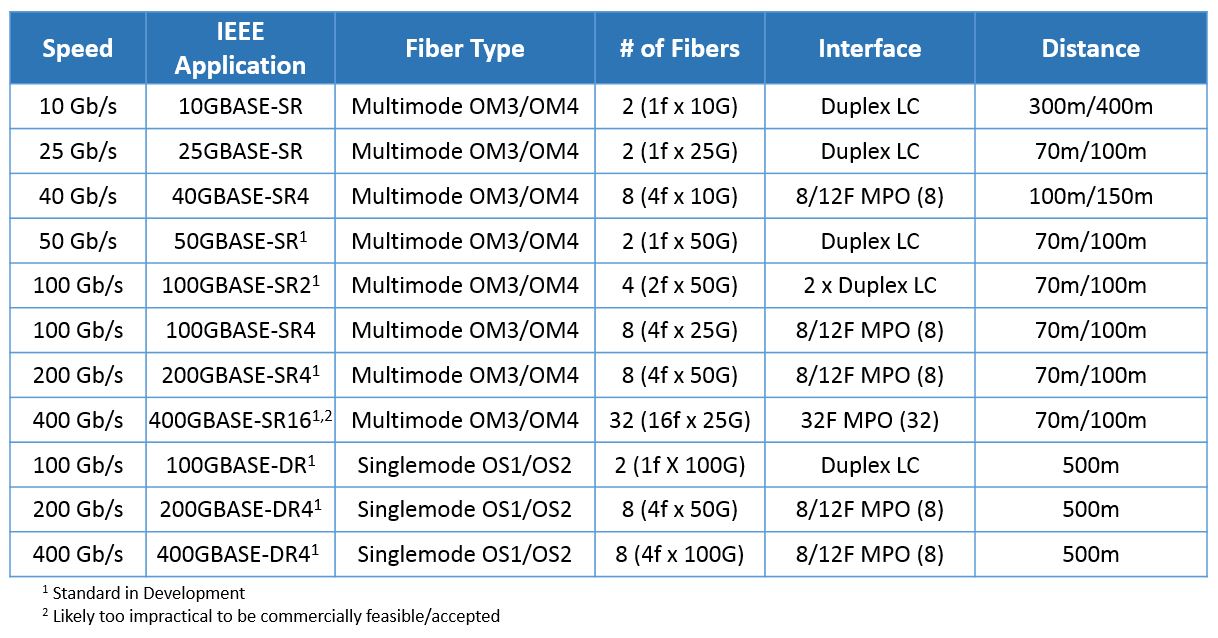
With MTP-12 and MTP-24 using in the data center for years, you may ask why there is still a need for MTP-8? In fiber optic industry, optical transceiver roadmap changes rapidly from 10G—40G—100G and even up to 400G (see the picture below). With faster speeds spreading out into data center racks and SANs, there is a need for a more manageable grouping. For 40G connections and above, data is usually carried over eight fibers, and terminated at the switch in a MTP-8 QSFP transceiver which combines eight fibers.

40G/100G/400G use MTP-8 solution 

From the picture, we can see that for Ethernet transmission ranging from 40G to 400G, all roads lead to 2-fiber and 8-fiber solution. For 40G/100G and future 400G applications, the use of 12-fiber MTP solution would result in 33% of the optical fibers unused. Thus it is expected that for 400G application, MTP-8 will gain widespread market acceptance.

MTP-8 Solution Benefits
 
Flexibility and 100% fiber utilization are the primary advantages of MTP-8 solution. Being wholly divisible by number “2”, MTP-8 solution can be easily used for two-fiber transceiver systems, just as MTP-12 solution can be. And for those who have deployed 12-fiber or 24-fiber trunk cables, how to ensure the 100% fiber utilization? MTP-8 can. You can use conversion cords or modules to transition two 12-fiber or one 24-fiber trunk from backbone cabling into three 8-fiber MTP for 40G/100G equipment connection. But in this process, conversion modules will introduce additional insertion loss into the channel and conversion cords. Thus deploying MTP-8 solution directly can ensure 100% fiber utilization without the additional cost and insertion loss of MTP-12 to MTP-8 conversion devices. In a word, for the most common 40G/100G/400G transceiver types, MTP-8 solution offers the most flexibility and uses the fibers to the fullest.

MTP-8 Solution in Data Center
 
As stated above, MTP-8 solution can be used in different applications. Here I’d like to show three examples.

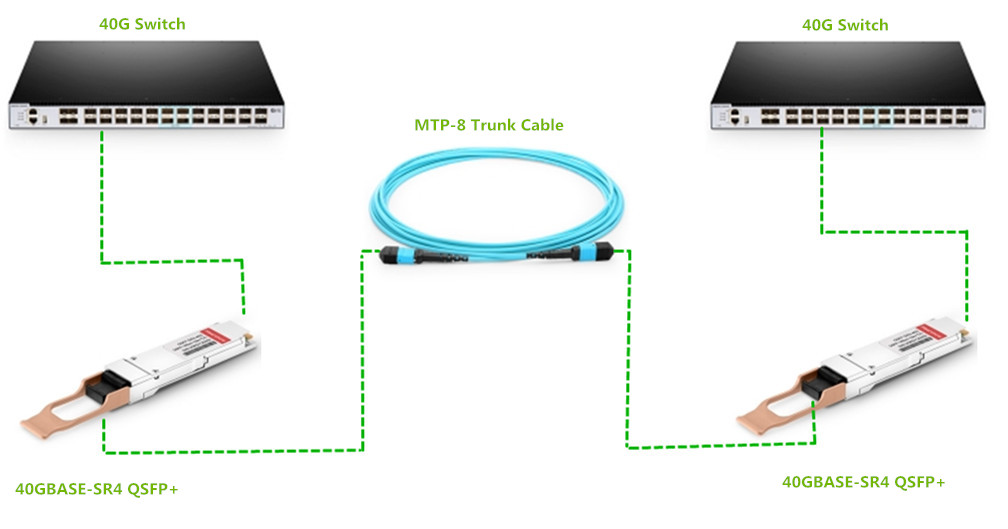
Example 1: MTP trunk cable in 40G 
 
In 40G data center, the simplest way to connect two 40G switches is to use the MTP trunk cable. As the picture shows, 40G data transmission can be achieved by connecting the both ends of the MTP trunk cable with the 40G QSFP transceivers inserted into the two 40G switches.

MTP-8 solution in 40G data center 

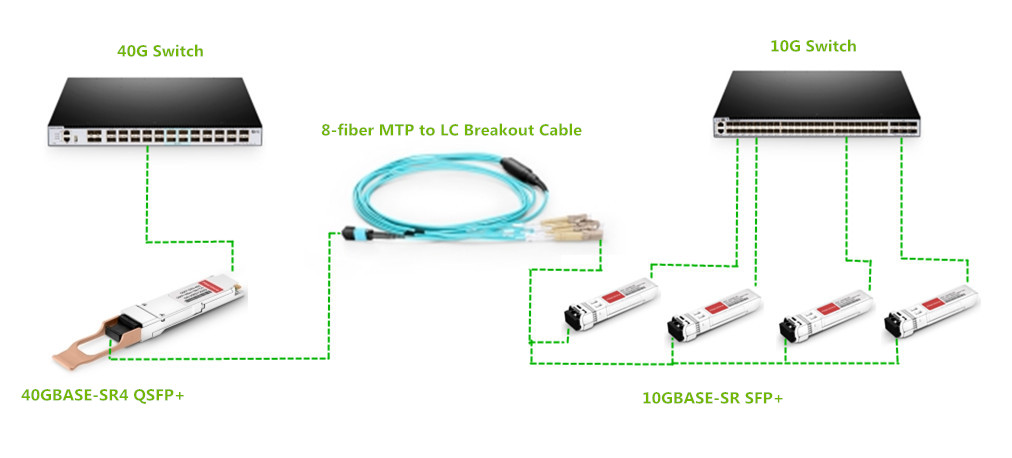
Example 2: MTP to LC breakout cable in 10G/40G
 
For 10G to 40G migration, using the MTP breakout cable is a simple way. As shown in the following picture, the MTP to LC breakout cable connects a 40G transceiver and four 10G transceivers. So the 40G data can be transmitted from 10G switch to 40G switch through the MTP to LC breakout cable.

8 fiber MTP-LC breakout cable in 10G/40G migration 

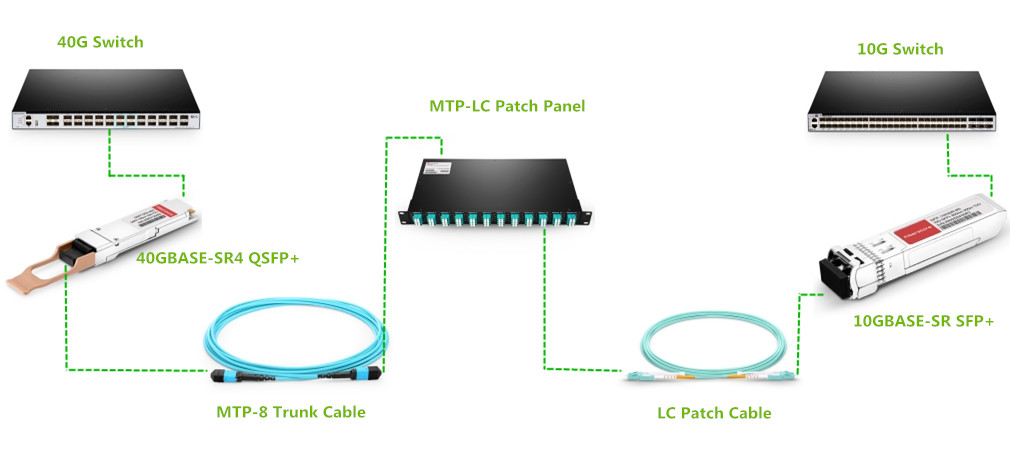
Example 3: MTP LC patch panel in 10G/40G
 
Besides using MTP breakout cable to achieve 10G to 40G migration, you can also use the MTP LC patch panel to fulfill 40G data transmission. The picture below shows the connectivity method. The 96 fibers MTP LC patch panel acts as a middleman between 10G to 40G connection. It has twelve 8-fiber MTP adapters on the rear and twelve 8 fiber LC adapters on the front. The MTP LC patch panel connects 40G QSFP ports with MTP trunk cable to the back of patch panel and then breaks out as 48 x 10G on the front with LC patch cords.

MTP-8 to LC patch panel in 10G/40G migration 

Summary
 
Supporting the current and future 8-fiber applications, MTP-8 is considered as the most efficient and the most future-proof connectivity solution. Anyone with a near-tern migration plan to adopt 40G or 100G in the data center will find great benefits in adopting MTP-8 connectivity solution. In all, MTP-8 solution can ensure data centers have the most cost-effective, future-proof network available, with a easier migration path that scales out to 400G transmission.